
on March 26th,2025
[Last Update on 9/29/2026]
Summary
A consensus mechanism in blockchain is the method a network uses to agree on which transactions are real, with no bank or authority calling the shots. Every node ends up holding the exact same ledger. Below we get into how that happens, why it matters, the attacks it blocks, and what the 2026 numbers say about where this is all heading.
Here’s the problem blockchain had to crack from day one. Take away the bank, the clearing house, the middleman, and you’re left with thousands of strangers who somehow need to agree on one version of the truth. None of them know each other. None of them trust each other.
A consensus mechanism is how they agree anyway. It’s the part of a blockchain that decides which transactions are valid and which get thrown out. Bitcoin, Ethereum, Solana, they all run on some version of it.
What is Consensus Mechanism?
Think about what happens when you tap a card. A bank sits in the middle, checks your balance, and either approves the payment or declines it. Blockchain hands that entire job to the network.
A consensus mechanism is the set of rules that lets every computer on a chain agree on the same record of transactions. Nobody signs off from the top. The network reaches the decision together.
For any Blockchain Development Company, choosing those rules is one of the first real decisions on a project. It shapes everything downstream: how fast the chain moves, what it costs to use, and how tough it is to attack.
What Does Consensus Mean in Blockchain?
Plenty of people treat “consensus” and “consensus mechanism” as the same thing. They aren’t, quite.
Consensus in blockchain is the agreement itself, the point where every node accepts the same state of the ledger. The mechanism is the how, the actual procedure that gets the network to that point. One is the outcome. The other is the route.
The distinction matters more than it sounds. When nodes can’t agree, the chain splits into two competing histories. A coin sitting on both is suddenly worth nothing on either.
How Does a Consensus Mechanism Work?
A consensus mechanism in blockchain enables a decentralized network to maintain integrity and prevent fraudulent activities. Here’s how it functions:
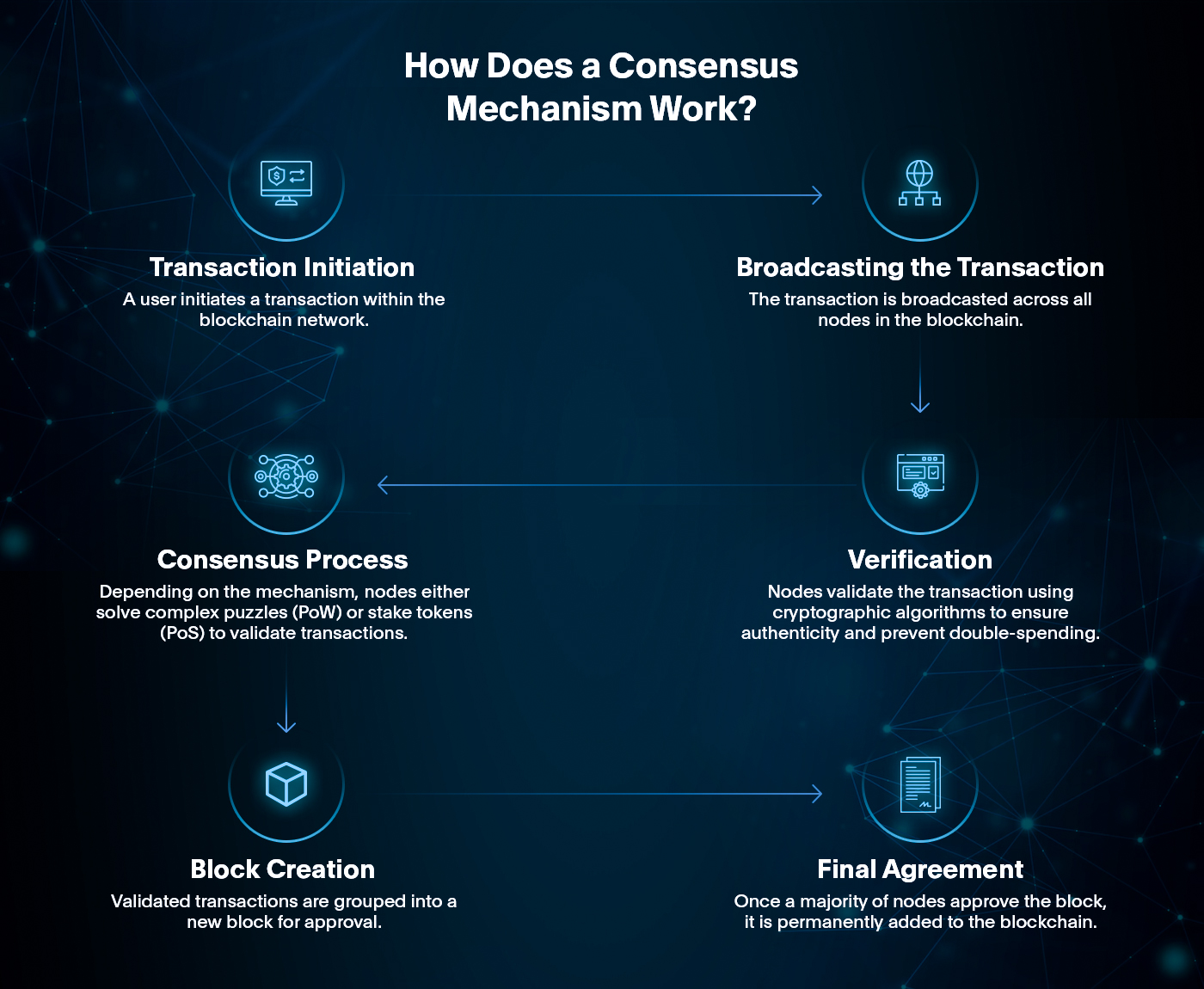
- Transaction Initiation – It starts with a user. Someone sends crypto or fires off a smart contract, and that request enters the network.
- Broadcasting the Transaction – The request doesn’t sit on one server. It gets shared out to every node at once, so they’re all looking at the same pending transaction.
- Verification – Each node checks the transaction against the cryptographic rules. They confirm the sender actually holds the coins and hasn’t already spent them, which is how double spending gets caught.
- Consensus Process – Now the network has to agree. Depending on the mechanism, nodes either compete to solve a puzzle (Proof of Work) or stake coins for the right to validate (Proof of Stake).
- Block Creation – The approved transactions get grouped into a new block, ready to join the chain.
- Final Agreement – Once the majority of nodes accept the block, it’s added to the blockchain for good. Then the whole cycle starts over with the next batch.
Why Are Consensus Mechanisms Important in Blockchain?
Consensus mechanisms play a crucial role in enterprise blockchain development services by ensuring:
- Trust in a Trustless System – Transactions are validated transparently without a central authority.
- Prevention of Double-Spending – Ensures the same asset is not spent multiple times.
- Enhanced Security – The decentralized nature and cryptographic validation prevent fraud and cyberattacks.
- Decentralization – Unlike traditional financial systems, blockchain relies on distributed validation, reducing central control.
- Scalability and Efficiency – Some consensus models, such as Proof of Stake, optimize transaction speeds and energy consumption.
The Blockchain Trilemma
There’s a constraint every network bumps into. Security, decentralization, and scalability tend to fight each other, and pushing hard on two usually costs you the third.
- Security is how well the chain shrugs off attacks.
- Decentralization is how widely control gets shared out.
- Scalability is how much traffic it handles before it chokes.
Bitcoin went with security and decentralization, and the bill for that shows up in speed. It clears only about seven transactions per second, according to Chainlink. Chains built for raw throughput usually give up some decentralization to hit those numbers. Figure out which corner a project sacrificed and its whole consensus design starts to make sense.
What Attacks Do Consensus Mechanisms Prevent?
Half the reason consensus matters is defense. A sloppy design opens the door to a few well known attacks, and a solid one makes them too costly to attempt.
- 51% attack. Get hold of more than half a network’s power and you can reverse recent transactions. Smaller chains like Ethereum Classic have been hit this way. On Bitcoin, the price tag is absurd.
- Double spending. Someone tries to spend the same coin twice, and verification catches the duplicate before it ever confirms.
- Sybil attack. One actor spins up a crowd of fake identities to tilt the network. Staking and mining costs make each fake identity too expensive to be worth it.
- Grinding attack. A validator games the selection process to grab more blocks. Newer designs randomize the pick, which kills the trick.
None of this is theoretical. It’s the reason the consensus mechanism sits dead center in every serious security audit.
Traditional vs Blockchain Consensus
Old style consensus leans on a single trusted authority. Blockchain spreads that trust across the network instead. Line them up and the difference jumps out.
| Feature | Traditional system (bank) | Blockchain network |
|---|---|---|
| Who validates | A central authority | Distributed nodes |
| Trust model | Trust the institution | Trust the code and the network |
| Point of failure | Single central server | No single point of failure |
| Transparency | Private, closed records | Open, shared ledger |
| Downtime risk | Can go offline | Runs around the clock |
The shift is the whole point. You stop trusting one institution to behave itself and start trusting a system nobody can bend on their own.
Types of Consensus Mechanisms
While we will cover these mechanisms in-depth in another blog, here is a brief overview of some widely used consensus mechanisms:
- Proof of Work (PoW) – Used by Bitcoin, it requires solving complex mathematical problems to validate transactions.
- Proof of Stake (PoS) – Validators stake cryptocurrency to confirm transactions, offering an energy-efficient alternative to PoW.
- Delegated Proof of Stake (DPoS) – A variation of PoS where elected representatives validate transactions on behalf of network participants.
- Proof of Authority (PoA) – Transactions are verified by a set of pre-approved nodes, increasing efficiency.
- Proof of Burn (PoB) – Participants destroy (burn) coins to gain mining rights.
- Proof of Elapsed Time (PoET) – Assigns random wait times to determine which node gets to validate the next block.
- Hybrid Consensus Models – Some blockchains combine multiple mechanisms to enhance performance and security.
Every one of them fits some projects better than others. We break all of them down in our guide to the types of consensus mechanism in blockchain.
Consensus Mechanisms in 2026: Latest Data and Trends
The past couple of years nudged consensus in one clear direction, away from heavy energy use and toward speed. The 2026 figures make the case.
| Data point | Figure (2026) | Source |
|---|---|---|
| Ethereum energy drop after moving to PoS | About 99.95% | Ethereum.org |
| ETH now staked under Proof of Stake | Roughly 32% of supply, near 39.7M ETH | Datawallet |
| Bitcoin Proof of Work energy use | More than several mid sized countries burn in a year | Cambridge CBECI |
| Bitcoin settlement speed | About 7 transactions per second | Chainlink |
Put together, they all point the same way. Proof of Stake keeps gaining ground, and the energy bill behind Proof of Work keeps drawing heat. Anyone weighing Blockchain Development Solutions is really weighing these trade offs before settling on a chain.
The Future of Consensus Mechanisms
The next fight is over speed, not just energy. Teams are racing to finalize a transaction in well under a second while keeping security tight.
Solana is the one worth watching. Its Alpenglow upgrade scraps the old Tower BFT and Proof of History setup and aims for finality of 100 to 150 milliseconds, down from about 12.8 seconds, with mainnet expected in late 2026, according to CoinDesk.
There’s also ongoing work on quantum resistant consensus, so chains stay safe as computers get more powerful. Different routes, one destination: agree faster, spend less, and stay hard to break.
Conclusion
Consensus mechanisms form the backbone of custom blockchain development services, ensuring decentralization, security, and efficiency in blockchain networks. Whether through PoW, PoS, or hybrid models, these mechanisms enable transactions without intermediaries, creating trust in digital ecosystems.
As blockchain adoption grows in the United States and India, businesses must understand how different consensus mechanisms work to fully harness the potential of blockchain technology. Stay tuned for our upcoming blog, where we will explore Types of Consensus Mechanisms in greater detail, helping you choose the right one for your enterprise needs. For expert guidance on enterprise blockchain development services, connect with a leading blockchain development company today!