
on November 24th,2025
Key Takeaways
- The average stablecoin development cost in 2026 ranges from $85,000 to $500,000+, depending on model, compliance scope, and ecosystem features.
- Reserve-backed stablecoins remain the most budget-friendly, while synthetic and cross-chain models sit at the higher end due to complex smart contracts and oracle setups.
- The biggest cost drivers are audits, compliance integrations, oracle infrastructure, chain selection, and the need for transparent reserve tracking.
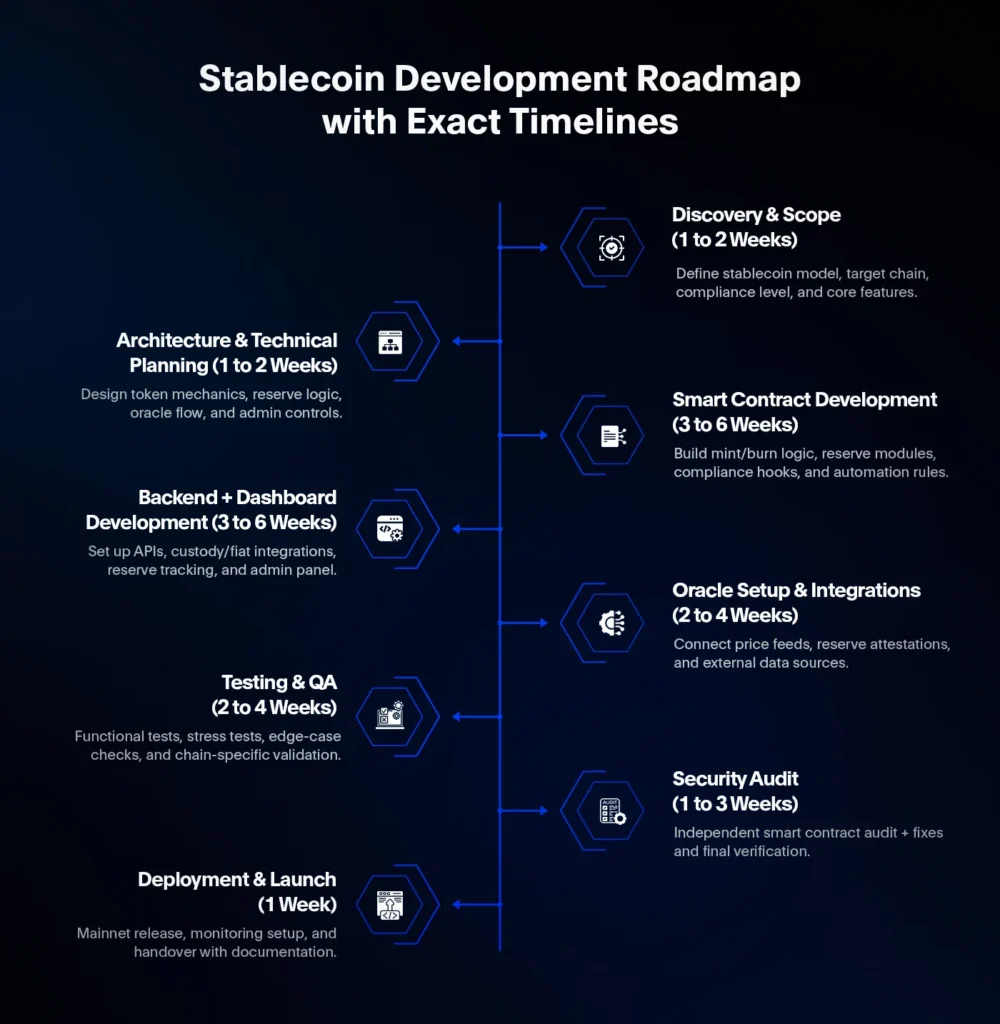
- A typical development timeline runs 12–24 weeks, depending on whether you need interoperability, custom admin dashboards, or regulatory automation.
- Choosing the right stablecoin development company directly affects cost, security, and long-term scalability, especially with rising 2026 regulatory pressures.
Stablecoins have come a long way from being a simple “crypto safe zone.” In 2025 alone, they processed over $7.4 trillion in on-chain settlement volume, a number that quietly surpassed the payment activity of several traditional networks. What’s even more interesting is how demand has shifted, businesses today aren’t looking for just another token. They’re exploring stable coin systems that can support real payments, treasury automation, cross-border settlements, and industry-specific use cases.
This shift is why the cost of building a stable coin in 2026 looks very different from what founders saw two or three years ago. Not because development became expensive, but because expectations around transparency, audits, stability mechanics, and compliance have evolved. A modern stable coin now needs clear collateral tracking, automated reporting, risk controls, and infrastructure strong enough to work across multiple chains.
Why Stablecoins Matter in 2026
Stablecoins are no longer just a bridge between crypto and fiat. In 2026, they’ve become part of larger financial workflows. For context, nearly 65% of on-chain value moved in Q1 2026 came from stablecoin transfers, not trading activity. Banks, fintech platforms, and even supply-chain companies now use them as operational assets, not speculative instruments.
What changed is the environment around them. Global payment rails are getting more fragmented, cross-border settlement fees remain high, and businesses still wait hours or days for international transfers. Stablecoins solve those frictions without asking companies to overhaul their entire system.
Three shifts explain why founders are exploring stable coin development more seriously in 2026:
Settlement Speed Became a Business Priority
Many enterprises measured the gap between bank transfers and tokenized settlement and found stable coins clear faster, with fewer intermediaries. That single advantage pushed internal finance teams to evaluate custom digital currencies for daily operations.
Real-Time Reporting Became a Must-Have
Regulators and auditors now expect near-instant reserve visibility. Stablecoins with automated attestation and transparent collateral dashboards quickly earned trust, making older “monthly report” models feel outdated.
Multi-Chain Liquidity Became the New Normal
Companies no longer want a stable coin tied to one chain. They expect it to move across multiple networks without friction, which changed the architecture and cost behind development.
Programmable Finance Started Replacing Manual Workflows
Stablecoins capable of automated payouts, scheduled settlements, and rule-based fund releases are more attractive to enterprises. This shift made smart contract automation a core part of development instead of an optional add-on.
RWA Growth Increased Demand for Stable Settlement Assets
Tokenized treasury bills, credit products, and real-world funds need a reliable unit of account inside their ecosystem. Custom stablecoins now act as the settlement layer for many RWA platforms, not just as a utility token.
Compliance Became Clearer and Stricter
Regions introduced more structured rules around asset-backed tokens, pushing stablecoin issuers to adopt better custody arrangements, risk controls, and reporting tools right from the beginning.
Treasury Automation Became a Competitive Edge
Large companies now design stablecoins that connect directly with their internal treasury systems. This reduces operational delays and eliminates repetitive manual work in multi-currency environments.
Emerging Stablecoin Models Gaining Adoption in 2026
Stablecoin architecture is shifting quickly. Instead of the old “fiat-backed vs algorithmic” debate, teams are now experimenting with models designed for specific financial environments. These categories don’t appear in most blogs because they’re fairly new, but they’re shaping how modern stablecoin development projects are planned and priced.
Multi-Reserve Stablecoins
These use a mix of assets treasury bills, commercial deposits, short-term debt instruments, and even tokenized RWAs to reduce dependency on a single reserve type.
The development cost increases because the token needs automated reporting, diversified collateral tracking, and integration with multiple custodians. Most founders rely on a stablecoin development company for this complexity.
Region-Specific Settlement Stablecoins
Designed for cross-border trade, especially in markets with unstable banking infrastructure.
They usually peg to a basket of local currencies instead of a single fiat currency.
The higher cost comes from the need for reliable FX feeds, regional compliance modules, and settlement logic tailored to specific corridors.
Programmatic Payment Stablecoins
These are stablecoins built around smart contracts designed for recurring payments, supplier settlement rules, and automated treasury flows.
The token itself is simple the cost sits in the rule engine, payout logic, dispute resolution flows, and integration with ERP tools.
Companies typically involve a smart contract development company for this category.
Yield-Integrated Stablecoins
These hold short-term government securities or on-chain RWAs and share a small portion of yield with the issuer or participants.
This model needs controlled treasury automation, compliance reporting, and a reserve strategy that updates daily — making it more expensive to build and maintain.
Institutional Settlement Tokens
These are not public tokens but internal settlement currencies used by banks, fintechs, or marketplaces.
Their value isn’t in liquidity but in predictable movement inside a closed ecosystem.
Costs depend on how deeply the token must integrate with legacy systems — an area where a Blockchain Development Company usually steps in.
Real-Time Attested Stablecoins
An emerging trend where reserve verification happens continuously through automated attestation feeds.
This appeals to enterprises that want transparency without manual audits.
The price goes up when a project needs automated dashboards, custodian proofs, and event-based alert systems.
Hybrid-Stability Tokens
A mix of collateral, on-chain rules, and guarded algorithmic parameters.
They’re designed to avoid the failures of older algorithmic tokens by limiting the automated part.
They take longer to engineer because stability modules need stress-testing and controlled behavior under extreme market events.
What’s Actually Driving Enterprise Stablecoin Adoption in 2026
Stablecoins didn’t become an enterprise priority overnight. The shift has been building quietly through real operational pressures — the kind that show up in treasury calls, quarterly audits, and cross-border vendor payouts. By early 2026, five forces have become impossible for businesses to ignore.
Settlement delays now create measurable financial risk
Companies dealing with global operations have faced repeated cross-border settlement delays over the past year. Missed cut-off windows, regional bank disruptions, and weekend payment backlogs are now affecting cash flow planning. Stablecoins remove those uncertainties by giving a predictable settlement window measured in seconds, not days which has become a genuine operational advantage, not just a tech upgrade.
Treasury teams need liquidity beyond banking hours
Campaign launches, international payroll, and vendor settlements don’t follow bankers’ schedules. Enterprises are tired of waiting for Monday morning to move funds or cover time-zone spillovers. Stablecoins solved this problem in the simplest way possible: funds move any time, any day. For treasury teams under pressure to maintain real-time liquidity, this is no longer optional.
Regulatory clarity finally gives enterprises the confidence they needed
Throughout 2023–2024, legal teams were the biggest barrier. But updated frameworks in the US, EU, and Asia changed the tone entirely. Compliance officers finally have defined rules around reporting, custody, risk scoring, and issuer obligations. This clarity didn’t create demand it unlocked existing demand that was stuck behind internal legal approvals.
Vendors and partners now prefer stablecoin payments
This trend is one enterprises didn’t expect. SaaS vendors, logistics partners, and even regional distributors have started offering stablecoin settlement options because it speeds up their own collections. For many companies, adoption is no longer a “strategic choice” it’s how they stay aligned with their global partner ecosystem.
Automation through smart contracts is cutting operational overhead
Enterprises are now experimenting with automated payouts, milestone-based settlements, escrow releases, and consumption-based billing — all powered by smart contracts. Once finance teams see how these automated flows reduce manual approvals and reconciliation efforts, stablecoin rails become the natural backbone. It’s cost reduction, not crypto enthusiasm, driving this shift.
Core Factors That Decide Stablecoin Development Cost
Stablecoin budgets in 2026 don’t look anything like they did two years ago. Enterprises aren’t asking, “How much does it cost to build a stablecoin?” anymore. They ask, “What exactly are we building — and how should it behave under our regulatory, operational, and liquidity constraints?”
That shift is what drives cost today.
Below are the actual cost factors that matter — the ones that shape the scope, timeline, and engineering depth for any stablecoin development company.
The Asset Backing Model You Choose
What the stablecoin is pegged to changes almost everything:
- Fully fiat-backed coins require custodial partners, attestation cycles, reporting pipelines, and wallet–bank reconciliation infrastructure.
- Commodity-backed coins (gold, tokenized treasury bills, or energy credits) need asset verification and storage integrations.
- Revenue-backed or yield-sharing models introduce risk engines and on-chain distribution logic.
- Overcollateralized crypto-backed designs need automated liquidation, oracle feeds, and risk weighting.
Each model has a different regulatory footprint, different smart contract architecture, and different operational cost layers. This is where scope expands fast.
The Compliance Perimeter You Must Operate In
This is the part competitors barely explain, but in 2026 it has become the line between a $40k MVP and a $350k enterprise-grade deployment.
Compliance affects:
- which jurisdictions the issuance can touch
- KYC/KYB model
- reporting frequency
- whether your coin can be distributed to retail users or only whitelisted entities
- audit requirements of reserves
- how redemption flows must be recorded
Even the structure of the smart contracts changes based on compliance needs — some require transfer restrictions, freeze/rollback capability, or real-time monitoring hooks.
The Redemption Engine
Everyone focuses on minting.
But enterprises learn quickly that redemption is where complexity and real cost sit.
Redemption may require:
- automated treasury pullbacks
- verification steps before burning
- settlement instructions to banks or custodians
- price checks
- fund-flow reports
- compliance triggers
If the stablecoin needs institutional-grade redemption (e.g., banks, fintech processors, or marketplaces), this becomes one of the most time-consuming development areas.
On-Chain Automation Requirements
If the stablecoin is more than a “mint and burn” token, costs rise here.
Examples that require deeper engineering work:
- automated interest distribution (for tokenized T-bill models)
- fee-sharing mechanisms
- configurable minting rights for multiple issuers
- time-locked or conditional transfers
- smart contract–driven treasury actions
- adjustable peg controls for programmatic assets
Any stablecoin with built-in automation quickly becomes a multi-contract architecture instead of a simple ERC-20-style token.
This adds audits, testing cycles, and operational logic.
The Chain (or Multi-Chain) Strategy
In 2026, most enterprises don’t launch on a single chain. They need presence where their users and partners operate.
Chain selection affects:
- gas economics
- developer tooling
- contract design patterns
- bridge connectors
- how exchanges integrate your asset
- compliance extensions (some chains require stricter checkpoints)
A multi-chain stablecoin is not “deploy contract → done.”
It requires:
- chain-specific oracle adapters
- chain-specific mint/burn controllers
- interoperability contracts
- monitoring pipelines
- emergency response logic
This is why multi-chain deployments typically cost 2–3x more — not because of development, but because of testing and risk controls.
Liquidity Infrastructure
Building a stablecoin without liquidity planning is like launching a payment network without merchants.
2026 stablecoin projects budget for:
- market-making arrangements
- treasury rebalancing workflows
- integration with OTC desks
- liquidity provisioning on DEXs
- wrapped versions across chains
- banking partners (if fiat-backed)
Even if the stablecoin development services only deliver the tech, enterprises must know that liquidity is a separate yet crucial cost bucket.
The Governance and Control Model
This determines how much operational tooling is required.
Questions that change the cost:
- Who approves minting rights?
- Does the issuer need an internal dashboard?
- Do multiple departments need separate permissions?
- Is there a requirement for activity logs and traceability?
- Is there a circuit breaker in case of exploits?
- Will there be a governance token or only admin keys?
A well-governed coin costs more upfront to build, but it reduces lifetime maintenance costs and audit issues. Mature enterprises understand this trade-off.
Integration Requirements With Existing Systems
This is a major 2026 cost driver because stablecoins are no longer “standalone projects.”
Common integration needs:
- ERP systems (SAP, Oracle, NetSuite)
- treasury management platforms
- custodial wallets
- compliance and AML monitoring tools
- internal accounting systems
- cross-border payout partners
Every integration adds authentication flows, data mapping, event listeners, and testing cycles.
This is where a Blockchain Development Company adds serious value, because on-chain logic must sync cleanly with internal finance operations.
The Audit Depth: Security, Compliance, Operational
Audits in 2026 aren’t limited to smart contracts.
Enterprises now require three separate ones:
- Security audit – smart contracts, oracle feeds, issuance/burn architecture.
- Operational audit – how reserves are handled, how treasury actions are triggered.
- Compliance audit – alignment with jurisdictional requirements.
The deeper the audit footprint, the higher the cost — but the lower the long-term legal risk.
Future-Proofing Features
Modern stablecoins often require capabilities that weren’t common a few years ago:
- role-based minting for multi-country operations
- adjustable fee parameters
- compliance upgrades without redeploying contracts
- modular architecture for new asset backing models
- real-time risk monitoring
- oracle upgradability
- automated reporting hooks
These features add cost but also prevent the stablecoin from becoming obsolete as regulations and markets evolve.
Stablecoin Development Cost Breakdown
| Stable Coin Development Component | Cost Range (USD) |
| Base Technical Build | $40,000 — $150,000 |
| Compliance & Regulatory Implementation | $30,000 — $200,000 |
| Asset Backing & Reserve Setup | $25,000 — $300,000 |
| Redemption Engine & Settlement | $20,000 — $150,000 |
| Multi-Chain Deployment | $15,000 — $75,000 (per chain) |
| Liquidity & Market-Making Setup | $10,000 — $200,000 |
| Security & Audit Bundle | $15,000 — $200,000 |
| Enterprise System Integrations | $15,000 — $120,000 (per system) |
| Annual Operational Run-Rate | $20,000 — $250,000 (Recurring) |
Base technical build: core token + issuance/redemption logic
What’s included: token contracts, mint/burn flow, role-based permissions, basic oracle hookup, admin dashboard for mint/burn, unit tests.
Why it costs: multi-contract architecture, secure mint/redemption flows, and initial oracle plumbing take engineering time and extra testing.
Range: $40,000 — $150,000
- Lower end = single-chain, simple fiat-backed or crypto-backed token with minimal admin UI.
- Higher end = upgradeable, modular contracts, complex redemption rules, and robust admin tooling.
Compliance & regulatory implementation (coding + processes)
What’s included: whitelist/blacklist controls, on-chain KYT hooks, event logging for audits, compliance reports, legal integration points.
Why it costs: compliance alters contract behaviour, requires audit trails, and often needs legal + engineering coordination across jurisdictions.
Range: $30,000 — $200,000
- Lower end = limited-jurisdiction corporate pilot with basic KYC gating.
- Higher end = multi-jurisdiction public issuance with continuous reporting and regulated custody workflows.
Asset backing & reserve setup (non-development costs + integrations)
What’s included: custodian integrations, attestation automation, bank/broker onboarding work, tokenized RWA integrations.
Why it costs: banking and custody work is operationally heavy and often requires third-party fees, legal work, and secure connectors.
Range: $25,000 — $300,000
- Lower end = using third-party custodians with standard APIs and monthly attestations.
- Higher end = bespoke custody agreements, automated on-chain attestations tied to multiple reserve instruments.
Redemption engine & settlement plumbing (underestimated area)
What’s included: bank/Custody settlement connectors, reconciliation logic, refund/dispute flows, conditional burn logic.
Why it costs: redemptions touch off-chain systems and need reliable, auditable processes failures here create real financial risk.
Range: $20,000 — $150,000
- Lower end = simple manual redemption with human-in-the-loop settlement.
- Higher end = fully automated clearing with bank rails and instant reconciliation.
Multi-chain deployment & bridges (per extra chain)
What’s included: chain-specific adapters, bridge integration, cross-chain mint/burn controllers, extra testing.
Why it costs: each additional chain multiplies testing and monitoring burdens and requires extra oracle adapters.
Range: $15,000 — $75,000 per additional chain
- Single-chain builds avoid this entirely; 2–3 chain strategies are common in 2026 for liquidity reasons.
Liquidity & market-making setup (technical + operational)
What’s included: market-maker integration scripts, DEX/AMM configuration, OTC desk onboarding templates, treasury rebalancing automation.
Why it costs: technical work is paired with commercial arrangements and ongoing ops to sustain peg and depth.
Range: $10,000 — $200,000 (often split between tech work and liquidity commitments)
Security & audit bundle (smart contracts + operations)
What’s included: 1–2 smart contract audits, operational security review, pen-test for admin tooling, bug-bounty program setup.
Why it costs: enterprises expect formal verification, multiple audit rounds, and operational security checks in 2026.
Range: $15,000 — $200,000
- Small projects may do a single audit; enterprise builds require repeated audits and larger bug-bounty budgets.
Integrations with enterprise systems (ERP, treasury, accounting)
What’s included: connectors to SAP/Oracle/NetSuite, payment gateway adapters, accounting event mapping, SSO and role sync.
Why it costs: integration requires mapping on-chain events to legacy bookkeeping and identity systems — often the most time-consuming part.
Range: $15,000 — $120,000 per major system
Post-launch annual run-rate (operations + compliance + monitoring)
What’s included: node hosting, oracle subscriptions, attestation/audit renewals, incident response, minor upgrades, support.
Why it costs: a stablecoin requires continuous monitoring, attestations, and occasional legal/tech patches.
Range (annual): $20,000 — $250,000
Consolidated 2026 Budget Tiers — realistic end-to-end cost (USD)
Each tier includes tech, compliance integration, basic liquidity planning, and initial audits. Post-launch run-rate is separate (see above).
- MVP / Pilot (single-chain, limited users, restricted geography): $80,000 — $150,000
Good for internal settlements or closed pilots where retail distribution isn’t required. - Mid-Size Enterprise (public issuance in 1–2 regions, full redemption flow, basic liquidity): $250,000 — $700,000
Typical for fintechs, marketplaces, and B2B platforms wanting full operational behavior and compliance. - Large Regulated / Multi-Chain (multi-jurisdiction, bank custody, automated attestations, MM liquidity): $800,000 — $2,500,000+
This covers complex custody arrangements, high audit depth, multi-chain presence, market-making commitments, and extensive integration with enterprise systems.
How Minddeft Technologies Helps to Develop stablecoin?
Building a stablecoin becomes far easier when the team behind it actually understands the cost drivers, compliance needs, and on-chain mechanics. At Minddeft, we start by mapping the exact scope so you get a clear picture of budget and timelines from day one. Our engineers use proven, audit-ready modules for mint/burn logic, reserve tracking, and smart contracts, which cuts both risk and development time. We also guide you on chain selection, stablecoin model, interoperability, and regulatory expectations so you don’t end up rebuilding things later. For businesses that want a stablecoin built right the first time, our experience as a stablecoin development company keeps the entire process predictable, secure, and future-ready.